Operating Patterns
Ways to do good work together, in a decentralised system
Common platform
A simple, universal need is met once, supporting multiple services cheaply and simply

Curation
Local services are surfaced in one place for a cohesive experience

Collaborative capacity
Different NHS organisations band together to solve a shared problem
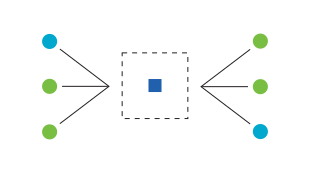
Market shaping
A dynamic market offers great products that compete on UX and price not vendor lock-in

Local innovation, scaled
A local innovation works, so it is invested in and opened up for others to use
Modular assembly
Local services are built from and augmented by common components and design standards
Why did we develop the operating patterns?
Decentralised systems like the NHS should be good at learning. They have real advantages: lots of people working close to problems, natural distributed intelligence, and people at the centre able to spot patterns and improve conditions.
When systems like this work well, good ideas can come from anywhere and spread anywhere. People can collaborate across layers and organisations, each contributing part of the solution. Progress made in one place benefits everyone.
Right now, this isn’t happening. Instead, the NHS is full of fragmentation and friction. Debates about devolution play out as a tug of war between local and national - arguments about where things should sit: budgets, technologies, decisions. Central mandation versus local discretion.
We call this Dated Devolution. It’s an outdated way of thinking about decentralised systems. And it’s a serious problem. It wastes money on duplication. It means the benefits of innovation and intelligence don’t spread. For almost every problem, someone, somewhere, has made progress - but no-one can access their learning.
The good news: this problem already has a solution. Across the NHS, many people are already working differently - they are enacting a more dynamic kind of devolution, in which people collaborate to do great work, anywhere, on behalf of everyone. We started mapping this work, and we noticed some patterns - common ways of getting great work done together in a decentralised system.
These are the operating patterns.
They offer a new grammar for devolution - a model of Digital-era Devolution.
They apply not just to the NHS in England, but to any decentralised system - from India’s public stack, to Germany’s education system, to any system of local government.
We’re sharing these patterns as a prototype. We’d love feedback. Are there missing patterns? Or refinements? Or case studies to bring this to life?
To read more detail about the thinking behind the operating patterns, see our Discussion Paper
About
Operating Patterns is an attempt to name some emerging strategies and ways of working in the NHS. It was created by James Plunkett from Kinship Works and Richard Pope from Platformland.