


About
Operating Patterns is an attempt to name some emerging strategies and ways of working in the NHS. It was created by James Plunkett from kinship.works and Richard Pope from RPP.
Why did we develop the operating patterns?
Decentralised systems like the NHS should be good at learning and improvement. Such systems have useful qualities - lots of people working close to problems, creating a form of distributed intelligence, and people at the centre (or centres) spotting patterns, and improving conditions.
If a system like this works well, good work can originate from anywhere, and spread anywhere. People can collaborate easily across layers and organisations, each offering part of the solution. And when people make progress on a problem, they do so for everyone.
As things stand, this isn’t how the NHS is working. Instead, the decentralised nature of the NHS seems to result in fragmentation and friction.
When the NHS debates devolution, it plays out as a tug of war between ‘local’ and ‘national’, as people argue over the level at which things - budgets, technologies, decisions - should sit in the system. And people debate the merits of central mandation, versus local discretion.
We think of this as Dated Devolution - an outdated way of thinking about decentralised systems.
And we believe Dated Devolution is a huge problem. It means the NHS wastes money on duplication. And it means we don’t spread the benefits of innovation and intelligence. For almost every problem, someone, somewhere, has made progress. But no-one can access their learning.
The good news is, this problem already has a solution. Across the NHS, many people are already working in ways that embody a different conception of devolution - a more dynamic view, in which people collaborate to do great work, anywhere, on behalf of everyone.
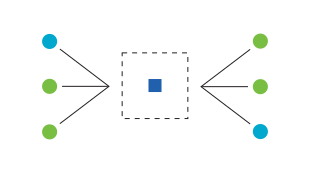
We started to map this work, and we noticed some patterns. There seemed to be some common ways of getting great work done together, in a decentralised system.
In this website we are sharing these operating patterns.
We think the patterns give us a new way to talk about devolution - a new language or grammar for devolution. Or a model of Digital-era Devolution.
We think the patterns apply not just to the NHS in England, but to any decentralised system - from India’s X, to X’s Y, to any system of local government.
We are sharing the patterns as a prototype to improve on. We would love to hear feedback - missing or refined patterns, or case studies of the patterns.